Durga Puja 2026
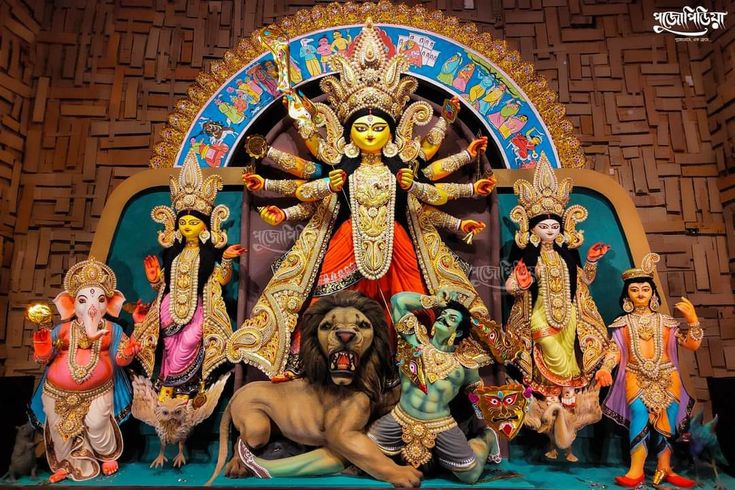
Join us in celebrating Durga Puja, the grandest festival of Bengali culture and one of the world's most vibrant cultural celebrations. Recognized by UNESCO as an Intangible Cultural Heritage of Humanity, Durga Puja is a unique festival that brings together art, devotion, creativity, and community on an extraordinary scale. Over five unforgettable days, immerse yourself in a rich tapestry of traditions, music, dance, cultural performances, and authentic Bengali cuisine. More than a festival, Durga Puja is a celebration of togetherness, diversity, and the triumph of good over evil. Whether you are discovering Bengali culture for the first time, reconnecting with your roots, or simply looking to experience something unique, everyone is welcome. Join us in the heart of Madrid to experience the warmth, joy, and spirit of a UNESCO-recognized tradition that continues to unite people across generations and cultures.
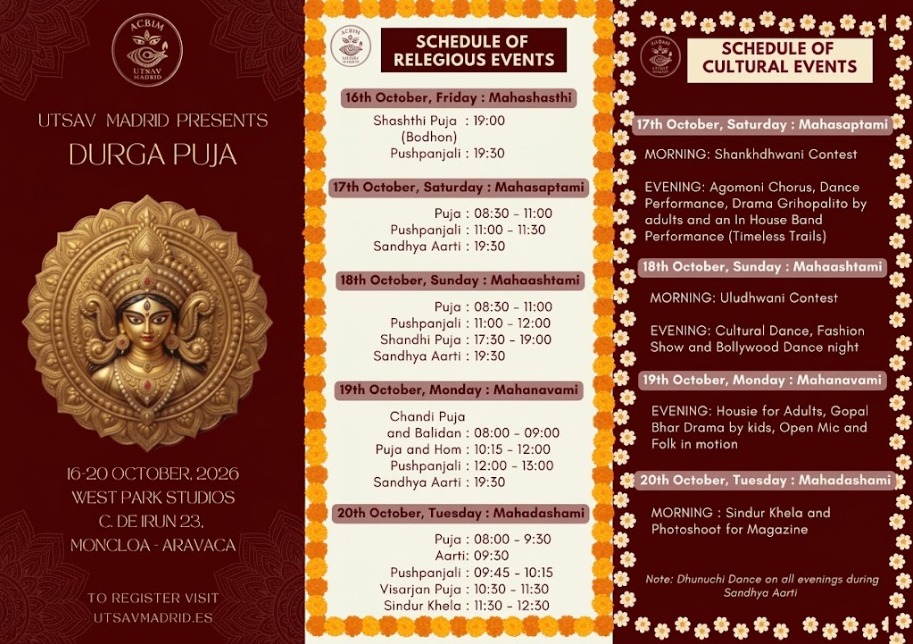
Schedule & Itinerary
Shashti — Friday 16 Oct
- 19:00
Mahashasti Puja ( Devi Bodhon)
Maha Shashti marks the official first day of the core Durga Puja celebrations. It is the day devotees welcome Goddess Durga as she arrives on Earth from Mount Kailash with her four children: Lakshmi, Saraswati, Ganesha, and Karthikeya. These rituals serve to symbolically awaken Goddess Durga (Bodhon), formally invite her to Earth (Amantran), consecrate the space to welcome her divine presence into the idol (Adhivas), and reveal her image to the devotees (Unveiling the Face) to officially begin the festival.
- 19:30
Aarti and Pushpanjali
On Shasti Evening, devotees offer Pushpanjali to welcome the newly awakened Goddess, immediately followed by a vibrant Aarati filled with light, incense, and the thunderous beats of the dhak.
Mahashaptami — Saturday 17 Oct
- 8:30 -11:00
Shaptami Puja
Mahashaptami signifies the day Goddess Durga began her epic battle against Mahishasura, symbolizing the triumph of inner strength over negativity. Additionally, the ritual worship of nine sacred plants honors the earth's vegetation and the ancient, nature-centric roots of the festival.
- 11:00 - 11:30
Pushpanjali
On Maha Shaptami, Pushpanjali serves as the community's very first collective floral offering to the fully awakened and life-infused Goddess.
- 19:30
Sandhya Aarti
The priest rhythmically waves a large, multi-tiered brass lamp (panchapradip) before Goddess Durga to honor her presence and dispel spiritual darkness. This is followed by the offering of incense, a conch shell, and a sacred whisk (chamar). Dhunuchi Naach truly kicks off. Devotees, fueled by the intense drumbeats, perform a frenzied, traditional dance while balancing clay pots filled with smoking, burning coconut husks and frankincense (dhuno).
Maha Ashtami — Sunday 18 Oct, 2026
- 8:30 - 11:00
Ashtami Puja
Maha Ashtami (or Durga Ashtami) is universally recognized as the most significant, powerful, and spiritually charged day of the entire Durga Puja festival. It commemorates the fierce avatar of the Goddess as Mahishasuramardini (the slayer of the buffalo demon) and is defined by deep fasting, massive community gatherings, and strict ancient rituals.
- 11:00- 12:00
Pushpanjali
Maha Ashtami Pushpanjali is the most significant, heavily attended, and emotionally charged flower offering of the entire Durga Puja festival. While Pushpanjali (offering flowers with cupped palms) happens on multiple mornings, the one on Maha Ashtami holds supreme spiritual importance for millions of devotees.
- 17:30 - 19:00
Sandhi Puja
Sandhi Puja is universally regarded as the absolute climax, highest point, and most sacred juncture of the entire Durga Puja festival. The word Sandhi means "junction," and this ritual honors a precise cosmic time window where the spiritual energy of the universe is believed to be at its absolute peak.
- 19:30
Sandhya Aarti
Maha Ashtami Sandhya Aarati is widely considered the most spectacular, spiritually charged, and visually mesmerizing Evening ritual of the entire Durga Puja festival. Ashtami Evening is when the famous Dhunuchi Naach reaches its competitive and exhilarating peak. Driven entirely by the wild rhythm of the dhaks, men, women, and children step onto the floor holding clay pots filled with smoking, burning coconut husks and powdered frankincense (dhuno), balancing them in their hands or even their teeth while dancing passionately in front of the deity.
Maha Navami — Monday 19 Oct
- 8:00 - 9:00
Chandi Puja and Balidan
A massive, consecrated sacrificial fire altar (havan) is built inside the pandal. The priests sit around the sacred fire to recite the complete Durga Saptashati (also known as the Devi Mahatmya or Chandi Path), which consists of 13 chapters and 700 powerful verses dedicated to the actions of the Goddess.
- 10:15 - 12:00
Maha Navami Puja and Hom
Maha Navami is the penultimate day of Durga Puja, commemorating the final moments before Goddess Durga vanquishes the buffalo demon Mahishasura. The rituals on this day are heavily focused on the powerful element of fire, intense scriptural chanting, and symbolic sacrifice to cleanse all remaining negativity.The sacred fire carries mantra vibrations to the cosmos to cleanse the environment, remove negative energies, and invoke Goddess Siddhidatri, culminating in the Purna Ahuti to signal the completion of the major rituals.
- 12:00 - 13:00
Pushpanjali
Maha Navami Pushpanjali is the bittersweet morning flower offering of the Durga Puja festival. Occurring right after the high-energy Sandhi Puja, it represents the final opportunity for devotees to offer formal, structured morning prayers to Goddess Durga before her departure on Dashami.
- 19:30
Sandhya Aarti
Maha Navami Sandhya Aarati is a poignant, sensory-rich Evening ritual that serves as the final, grand Evening celebration of the core Durga Puja festival. The Navami Evening aarati is characterized by a bittersweet mix of peak festive energy and a collective reluctance to say goodbye.
Vijaya Dashami - Tuesday, 20 Oct
- 8:00 - 9:30
Dashami Puja
Maha Dashami (also known as Vijayadashami) is the final, deeply emotional day of Durga Puja. It marks the bittersweet culmination of the festival, celebrating Goddess Durga's triumph over the buffalo demon Mahishasura while simultaneously bidding her a tearful farewell as she returns to her heavenly abode on Mount Kailash.
- 9:30
Aarti
Bijoya Aarati (also known as the Dashami morning aarati) is the final, highly emotional prayer with lamps performed on the morning of Vijayadashami. Unlike the high-energy Evening aaratis of the previous days, this ritual carries a deeply solemn, bittersweet tone as it signals that Goddess Durga’s stay on Earth has officially come to an end.
- 9:45 - 10:15
Pushpanjali
Dashami Pushpanjali is the very final flower offering of Durga Puja, performed on the morning of Vijayadashami. It serves as a deeply emotional, tearful farewell prayer right before the Goddess's divine energy is ritually released from the clay idol.
- 10:30 - 11:30
Visarjan Puja
The Darpan Visarjan (or Mirror Immersion) is one of the most spiritually profound, mystical, and emotionally moving highlights of Dashami morning. It serves as the exact transition point where the religious worship ends and the physical farewell begins.
- 11:30 - 12:30
Shidur Khela
Sindoor Khela (literally meaning "vermilion game") is a vibrant, joyous, and visually spectacular ritual celebrated on Vijayadashami, the final day of Durga Puja. It acts as a grand, colorful farewell party for Goddess Durga before her physical idol is taken for immersion.
Shashti — Friday 16 Oct
- Evening
Puja Inauguration and Musical showcase by Members
The festival opens with a warm community welcome, music, and the first shared atmosphere of celebration as families gather together for the beginning of Durga Puja.
- Evening
Antakshari
A fun-filled musical game where participants sing songs in a chain, testing their memory and musical knowledge.
Mahashaptami — Saturday 17 Oct
- 10:30 - 11:30
Children Art Contest
Children between 2 to 12 years old participate in a art contest. Request to bring own colouring sets. Sheets will be provided at the venue.
- 13:00 - 13:15
Shankhdhwani (conch blowing) contest
Participants compete in blowing the conch with skill and precision, adding a traditional and spirited element to the cultural festivities.
- 13:20 - 13:30
Tongue twisters challenge
Participants compete in reciting challenging tongue twisters quickly and accurately.
- Evening
Agomoni chorus
A traditional chorus performance that marks arrival of Maa Durga.
- Evening
Kids group dance
A lively group dance performance by children.
- Evening
Timeless trails (Band performance)
A live band performance that energizes the audience with music and rhythm.
Maha Ashtami — Sunday 18 Oct, 2026
- 10:30 - 11:30
Poetry recitation
Participants recite poems, showcasing their literary skills and expressive abilities.
- 13:00 - 13:15
Uludhwani contest
Participants compete in producing uludhwani, a traditional sound signaling the festive spirit.
- 13:20 - 13:35
Durga Puja quiz contest
A fun segment where participants answer questions about Durga Puja mythology and traditions.
- Evening
Ladies Group Dance
A lively group dance performance celebrating the festive spirit.
- Evening
Fashion show
- Evening
Adults drama
A modern day short drama by adults.
- Evening
Bollywood night
Bollywood dance and music.
Maha Navami — Monday 19 Oct
- Evening
Tambola
Fun game of Tambola.
- Evening
Open mic
Open to all.
- Evening
Kids drama
Gopal Bhar drama by kids.
- Evening
Folk in motion
A folk rendition celebrating Bengali music.
Vijaya Dashami - Tuesday, 20 Oct
- Morning
Photoshoot
Capture the final moments of the festival with a memorable photoshoot.
Activities & Experiences
Puja & Pushpanjali
Experience the beauty of a timeless ritual as you offer flowers at the altar amid sacred Vedic chants, invoking blessings, peace, and devotion.
Food Stalls
Experience the diversity of Indian food— all freshly prepared by community volunteers.
Cultural Stage
Experience a vibrant showcase of classical, folk, and contemporary dance, music, art, and drama, take part in exciting competitions, or sign up to perform yourself. All ages, skills, and styles are welcome.
Sindoor Khela
Experience the beloved tradition where married women play with vermillion, celebrating joy and bidding farewell to the goddess.
Children's Corner
Experience a world of music, dance, art, performances, and exciting competitions, where children of all ages can showcase their talents, unleash their creativity, and celebrate the festive spirit together.
Support Durga Puja 2026
Your contribution helps us bring the pujas, cultural programme and community feast to life. Every donation makes a difference.